- Blaser Ventures transformed a nearly 60-year-old medical office into Victory Heights housing.
- The $35 million project offers 88 units for low-income residents in Salt Lake City.
- Officials praise the mixed-income development for its community benefits and building preservation.
SALT LAKE CITY — Brandon Blaser spent the first few decades of his career in housing reviewing spreadsheets and crunching numbers to make developments work.
However, when he started his own company in Utah, he quickly took on a project that — looking back at it now — didn't make much sense on a spreadsheet.
His company, Blaser Ventures, acquired an aging medical office building across the street from Holy Cross Hospital in Salt Lake City. The plan was to convert the nearly 60-year-old building, at 1060 E. 100 South, into an affordable housing complex within the northeast corner of Central City.
That led to the creation of Victory Heights, a $35 million project to transform the space into 66 studio units and 22 three-bedroom or four-bedroom units for people making 25% to 50% of the area median income.
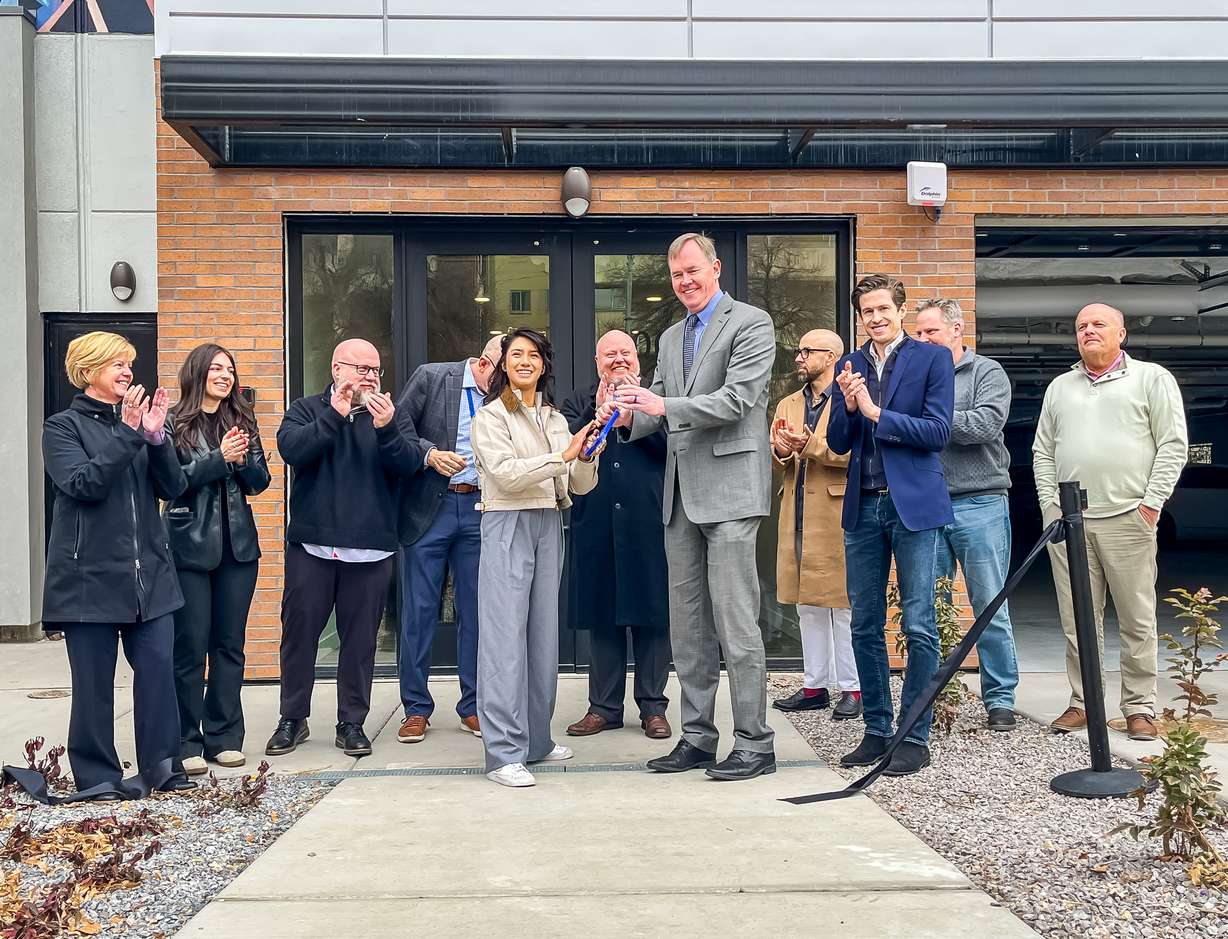
Approximately half of the 88 units are already leased, but state housing officials and city leaders joined the company in celebrating the completion of the project on Tuesday. There, they relished a complex project that was more expensive than what they had initially believed.
"I think we did it because we didn't know any better," said Blaser, founder and CEO of Blaser Ventures, as he reflected on that decision.
An 'impeccable' location
Blaser founded his company in 2018, and the aging office building across from Holy Cross Hospital ended up on his radar.
It had undergone improvements in the past, but many of the doctors, dentists and others who had set up shop had either retired or moved out. It was struggling to bring in replacements, with its owner — an international entity — seemingly uninterested in regularly maintaining it.
Previous efforts to sell it fizzled out. Blaser suspects that others balked at the amount of work that would be needed to transform the space into a desirable office building.
He saw potential in taking it into a completely different direction, though. It had a sturdy garage and a layout more appealing for housing than office space, and it was located between the University of Utah and downtown.
"We bought it without a business plan necessarily in mind. We just knew the location was impeccable," he told KSL. "We knew that we were onto something ... and we could figure out something when pulling in the different resources to make affordable (housing) work."
This was in late 2020 or 2021, when many wondered what would happen to office buildings with so many of them empty during the COVID-19 pandemic. While more employers have ended remote work since then, newer office buildings have fared better at bringing in tenants than older buildings.
He met with Chris Parker, co-director of the Perpetual Housing Fund and director of Giv Group, and others who outlined how to make the vision work, including financial incentives to turn the space into affordable housing.
Salt Lake City's Community Reinvestment Agency approved over $2.1 million in loans for the project, and the Utah Housing Corporation handled the issuance of bonds and tax credits that went into the mix of public and private funding that supported the project.
Creating community benefits
Actually converting the space into housing was another story. The team chose to adaptively reuse the building for the sustainable and community benefits, but crews didn't have any records to work with and ran into new challenges along the way that increased the final cost.
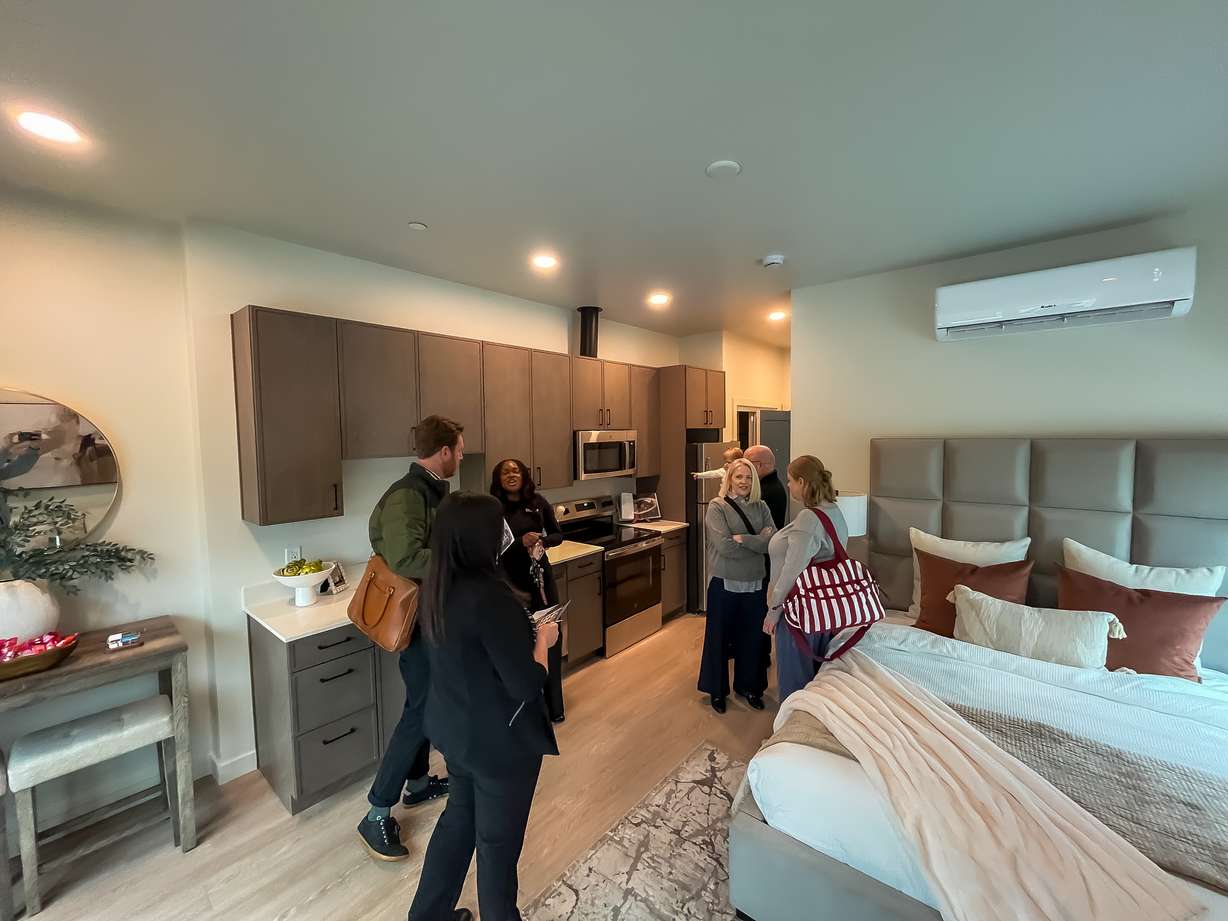
Although the numbers didn't necessarily align, likely impacting any bottom line, he's happy with the outcome. Monthly rents range from as low as $474 to $1,011 for a studio to $1,251 to $1,643 for a four-bedroom apartment, depending on household size and income. It offers opportunities for people to live in a part of the city they may not have been able to afford otherwise.
"It's a true mixed-income, welcoming neighborhood. The opportunity to put 88 families here was just one we couldn't pass up," he said. "This is a once-in-a-generation opportunity."
City and state officials agree.
Steve Waldrip, senior housing adviser to Gov. Spencer Cox, pointed to a new Harvard University study that found significant benefits for children who grew up in a former federal housing program that introduced them into mixed-income neighborhoods. These ranged from more educational opportunities and higher wages to lower incarceration rates.
"We know that stable housing produces all of the things that we care about," Waldrip said. "It's not correlation, it's causation. It produces higher education outcomes, it produces higher community engagement, it produces more wealth (and) it drives health."
There aren't many projects like this east of 700 East in the city, said Salt Lake City Councilwoman Eva Lopez Chavez, who represents the neighborhood and also serves as vice chair of the Reinvestment Agency board.
She believes the development adds value to the area, while preserving a piece of its history. It'll provide housing for service workers, nurses and other working-class people.
"This is the type of project that we want to continue fostering," she said. "This is an example of the right type of housing we want to promote."