'%3e%3cpath%20d='M34.1406%205.85938C30.3906%202.10547%2025.3047%200%2020%200C14.6953%200%209.60938%202.10547%205.85938%205.85938C2.10938%209.61328%200%2014.6953%200%2020C0%2025.3047%202.10547%2030.3906%205.85938%2034.1406C9.61328%2037.8906%2014.6953%2040%2020%2040C25.3047%2040%2030.3906%2037.8945%2034.1406%2034.1406C37.8906%2030.3906%2040%2025.3047%2040%2020C40%2014.6953%2037.8945%209.60938%2034.1406%205.85938ZM37.0117%2023.543H31.1602V13.5391H27.6328V19.9414C28.1211%2020.6914%2028.3711%2021.582%2028.3711%2022.5625V22.625C28.3711%2023.668%2028.1172%2024.6055%2027.6328%2025.4297V26.6094H36.082C33.4883%2032.9375%2027.2891%2037.3789%2020.0039%2037.3789C10.3711%2037.3789%202.62109%2029.6289%202.62109%2020C2.62109%2010.3711%2010.3711%202.62109%2020%202.62109C29.6289%202.62109%2037.3789%2010.3711%2037.3789%2020C37.3789%2021.1484%2037.2617%2022.2656%2037.0508%2023.3477C37.0391%2023.4141%2037.0234%2023.4766%2037.0117%2023.543Z'%20fill='white'/%3e%3cpath%20d='M22.3086%2018.5352C20.4336%2018.125%2019.9531%2017.8398%2019.9766%2017.1836V17.1406C19.9766%2016.6992%2020.3477%2016.2148%2021.4023%2016.2148C22.582%2016.2148%2023.8867%2016.6797%2025.0781%2017.4766L26.8516%2015.0195C25.4453%2013.8906%2023.707%2013.3398%2021.5547%2013.3398C18.5195%2013.3398%2016.4375%2015%2016.4063%2017.4766V17.5352C16.3633%2020.2617%2018.5859%2020.9805%2021.293%2021.6016C23.0391%2021.9766%2023.5703%2022.3164%2023.5703%2022.9609L23.5469%2022.9766C23.5469%2023.3906%2023.2578%2023.7031%2022.7852%2023.8359C22.5742%2023.9062%2022.1289%2023.9727%2021.5156%2023.9727C20.7617%2023.9727%2019.7539%2023.8633%2018.6328%2023.4844C18.0898%2023.2891%2017.4727%2023.0039%2016.8047%2022.6133L20.1406%2026.625C20.2813%2026.6602%2021.0977%2026.8516%2021.7734%2026.8516C25.0039%2026.8516%2027.0859%2025.2461%2027.1094%2022.6328V22.5703C27.1602%2020.1133%2025.2148%2019.1719%2022.3086%2018.5352Z'%20fill='white'/%3e%3cpath%20d='M5.24219%2013.5664V26.6133H8.75391V23.7578L10.2969%2021.9531L14.2031%2026.6133H18.3867L12.3555%2019.5195L17.4023%2013.5664H13.4531L8.75391%2019.0586V13.5664H5.24219Z'%20fill='white'/%3e%3c/g%3e%3cdefs%3e%3cclipPath%20id='clip0_97_2430'%3e%3crect%20width='40'%20height='40'%20fill='white'/%3e%3c/clipPath%3e%3c/defs%3e%3c/svg%3e)


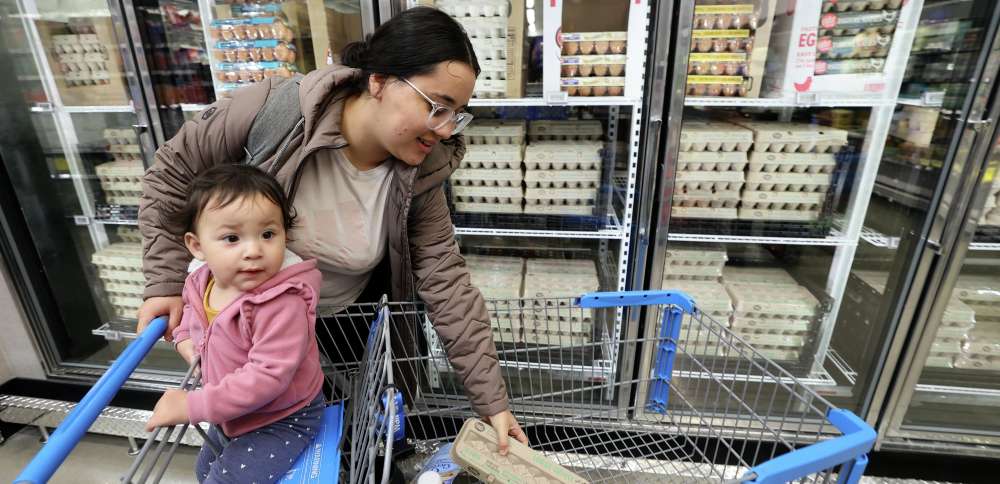
- A new Deseret News survey showed 85% of Utahns are concerned about the economy.
- Inflation is the top worry, with 51% citing rising costs of necessities.
- Housing costs also strain budgets; 30% of people spend over 30% of income on housing.
SALT LAKE CITY — A new statewide survey reveals deep concerns among Utahns when it comes to the current state of the economy and identifies their biggest single worry when it comes to managing household budgets.
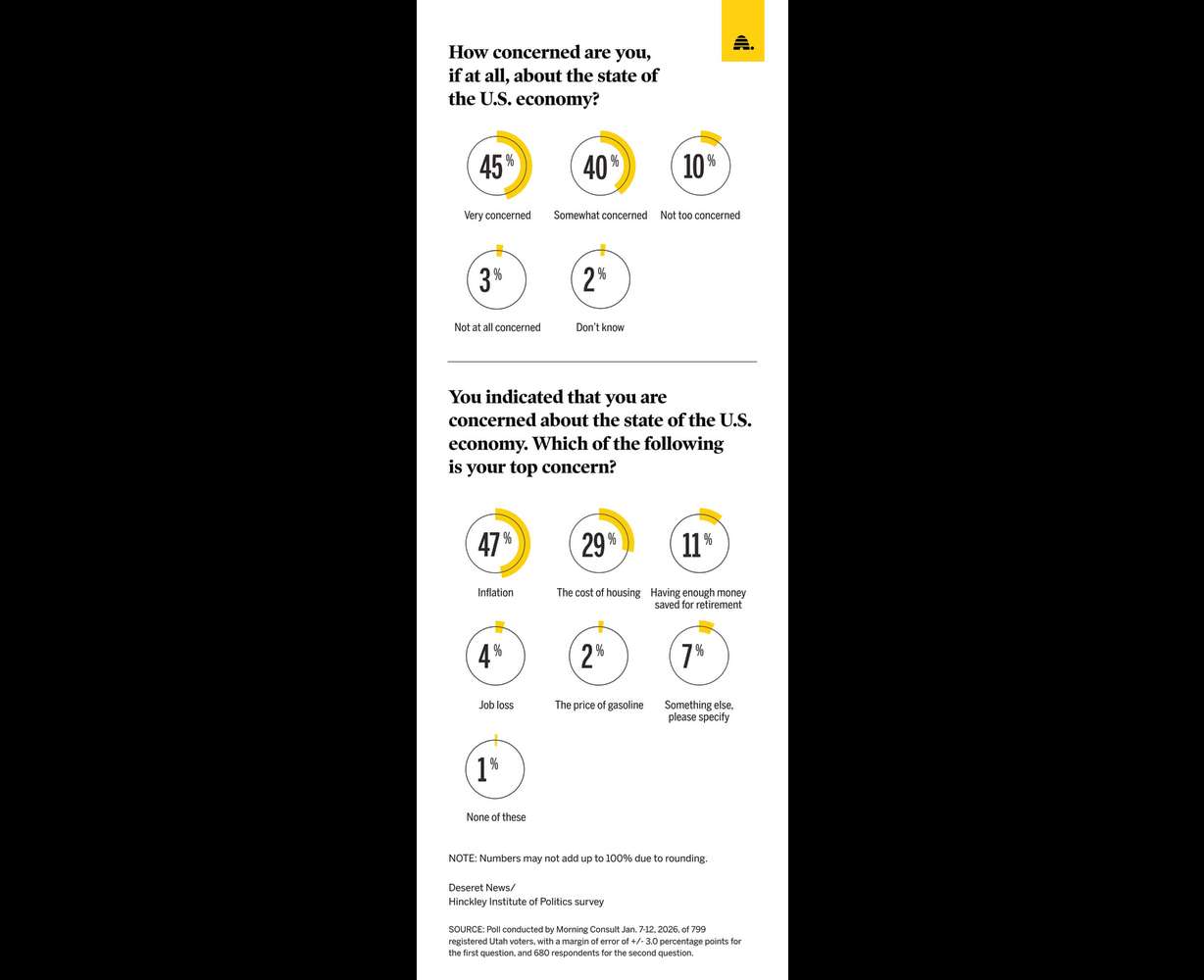
The Deseret News/Hinckley Institute of Politics poll, conducted Jan. 7-12 of 799 registered Utah voters, finds an overwhelming proportion of respondents, some 85%, reporting they are somewhat or very concerned about the country's economy. Just 13% told poll takers they were not at all or not too concerned about economic conditions and 2% said they weren't sure.
While the level of concern over the economy was fairly consistent across respondents' age and income groups, some division was apparent when participants were parsed by political affiliation.
Concern was notably higher among those who identified as Democrats, 96%, versus Republican poll participants, 76% of whom said they were very or somewhat concerned about the economy.
Among those respondents worried about the economy, inflation emerged as the dominant issue, cited by 47% as their top concern. The cost of housing ranks second at 29% while retirement savings concerns, 11%, and job loss, 4%, lagged well behind.
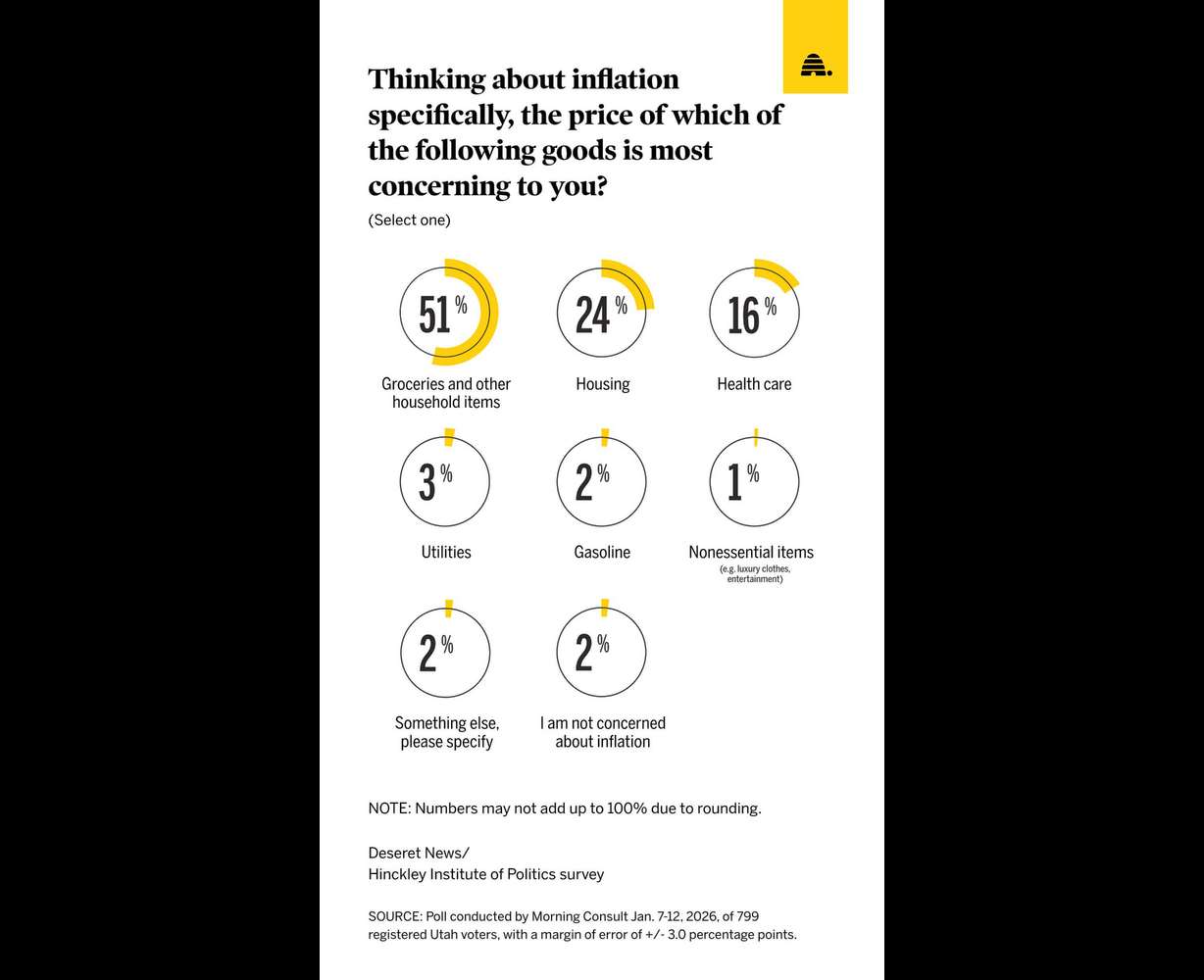
When asked to think specifically about inflation, a majority of respondents pointed to the rising costs of basic necessities as the most troubling economic issue.
Groceries and other household items were the top concern for 51% of Utahns who participated in the poll, followed by housing costs, 24%, and health care, 16%. Utilities, 3%, and gasoline, 2%, ranked much lower, and 1% of respondents were most concerned about nonessential items. Only 2% indicated they were not concerned about inflation at all, highlighting how pervasive inflation-related anxiety remains, particularly around basic living expenses.
While inflation was the top concern regardless of age, income and/or political affiliation, for poll participants in the 18-34 age group, it barely edged out housing costs, 39% to 38%, as their foremost fiscal worry.
The new survey data comes with a margin of error of plus or minus 3 percentage points.
What's been going on with inflation?
The latest federal reporting show inflation continues to run well above the target rate for policy setting bodies like the Federal Reserve.
The Jan. 13 Consumer Price Index report from the Labor Department found the average prices of goods and services increased by 0.3% on a monthly basis in December and were up 2.7% from the same time a year ago, matching November's annual rate. The core inflation rate, which strips out volatile food and energy prices, clocked in at 2.6% in December, down 0.1% from November's core reading.
Grocery prices saw their biggest one-month increase in three years in December, but price drops in other categories, including gasoline, helped offset the jump in food costs as inflation held steady in the final month of 2025.
Housing-related costs, which account for over one-third of the CPI inflation calculation, moved up 0.4% from November to December and were 3.2% higher on an annual basis last month. Grocery prices increased 0.7% in December, the biggest one-month increase since October 2022, and were 2.4% higher over the last 12 months. Prices for restaurant dining are up 4.1% from the same time last year.
The financial shadow of housing costs
The latest Deseret News/Hinckley Institute of Politics survey results reflect the ongoing financial issues for many Utah households amid challenging economic circumstances.
Statewide polling conducted last fall found 51% of respondents reporting they were managing to cover expenses but faced difficulty saving money, and 25% said they were financially strained and struggling to cover basic expenses. Less than a quarter of poll participants, 22%, said they were feeling financially secure and comfortably covering their living expenses.
While the cost of groceries and basic necessities was identified in the latest poll as the top worry for Utahns, the escalating costs of housing can cast a shadow across other expense categories.
Related:
This issue dwarfs all others for Utah voters as legislative session begins
Housing affordability is the No. 1 issue Utah voters want the Legislature to address according to a new Deseret News/Hinckley Institute of Politics poll.Phil Dean, chief economist at the University of Utah's Kem C. Gardner Policy Institute, noted in an earlier interview that for many Utah families, household budgets are being strained thanks to an outsized proportion of their incomes going to cover housing costs.
"My first thought after seeing a quarter of respondents reporting they are struggling to cover expenses is our current housing dynamic," Dean said. "When you look at the housing data, we have about 30% of people paying more than 30% of their income on housing. Thirty percent is the standard affordability metric, and if you are paying above that, you're likely encountering broader financial challenges."