'%3e%3cpath%20d='M34.1406%205.85938C30.3906%202.10547%2025.3047%200%2020%200C14.6953%200%209.60938%202.10547%205.85938%205.85938C2.10938%209.61328%200%2014.6953%200%2020C0%2025.3047%202.10547%2030.3906%205.85938%2034.1406C9.61328%2037.8906%2014.6953%2040%2020%2040C25.3047%2040%2030.3906%2037.8945%2034.1406%2034.1406C37.8906%2030.3906%2040%2025.3047%2040%2020C40%2014.6953%2037.8945%209.60938%2034.1406%205.85938ZM37.0117%2023.543H31.1602V13.5391H27.6328V19.9414C28.1211%2020.6914%2028.3711%2021.582%2028.3711%2022.5625V22.625C28.3711%2023.668%2028.1172%2024.6055%2027.6328%2025.4297V26.6094H36.082C33.4883%2032.9375%2027.2891%2037.3789%2020.0039%2037.3789C10.3711%2037.3789%202.62109%2029.6289%202.62109%2020C2.62109%2010.3711%2010.3711%202.62109%2020%202.62109C29.6289%202.62109%2037.3789%2010.3711%2037.3789%2020C37.3789%2021.1484%2037.2617%2022.2656%2037.0508%2023.3477C37.0391%2023.4141%2037.0234%2023.4766%2037.0117%2023.543Z'%20fill='white'/%3e%3cpath%20d='M22.3086%2018.5352C20.4336%2018.125%2019.9531%2017.8398%2019.9766%2017.1836V17.1406C19.9766%2016.6992%2020.3477%2016.2148%2021.4023%2016.2148C22.582%2016.2148%2023.8867%2016.6797%2025.0781%2017.4766L26.8516%2015.0195C25.4453%2013.8906%2023.707%2013.3398%2021.5547%2013.3398C18.5195%2013.3398%2016.4375%2015%2016.4063%2017.4766V17.5352C16.3633%2020.2617%2018.5859%2020.9805%2021.293%2021.6016C23.0391%2021.9766%2023.5703%2022.3164%2023.5703%2022.9609L23.5469%2022.9766C23.5469%2023.3906%2023.2578%2023.7031%2022.7852%2023.8359C22.5742%2023.9062%2022.1289%2023.9727%2021.5156%2023.9727C20.7617%2023.9727%2019.7539%2023.8633%2018.6328%2023.4844C18.0898%2023.2891%2017.4727%2023.0039%2016.8047%2022.6133L20.1406%2026.625C20.2813%2026.6602%2021.0977%2026.8516%2021.7734%2026.8516C25.0039%2026.8516%2027.0859%2025.2461%2027.1094%2022.6328V22.5703C27.1602%2020.1133%2025.2148%2019.1719%2022.3086%2018.5352Z'%20fill='white'/%3e%3cpath%20d='M5.24219%2013.5664V26.6133H8.75391V23.7578L10.2969%2021.9531L14.2031%2026.6133H18.3867L12.3555%2019.5195L17.4023%2013.5664H13.4531L8.75391%2019.0586V13.5664H5.24219Z'%20fill='white'/%3e%3c/g%3e%3cdefs%3e%3cclipPath%20id='clip0_97_2430'%3e%3crect%20width='40'%20height='40'%20fill='white'/%3e%3c/clipPath%3e%3c/defs%3e%3c/svg%3e)




- BYU faces Arizona with coach Kalani Sitake's future in question amid resource issues.
- Sitake's comments highlight frustrations over unmet promises and football funding at BYU.
- Success may increase Sitake's market value as BYU seeks Big 12, CFP achievements.
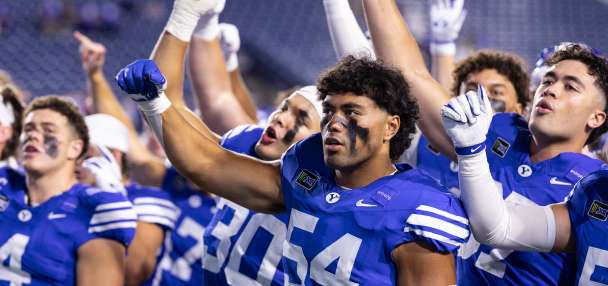
BYU has asked fans to wear blue and white Saturday afternoon -- it's affectionately called a Stripe Out -- to match the uniform design planned for one of the most important games of the season.
Although well-intentioned, the Cougars missed an opportunity. They should have turned the date with Arizona into a fan giveaway day.
The ideal gift: double-edged swords.
We're joking, of course. But there is some truth — some ice cold truth — to the suggestion. As the Cougars take aim at the Big 12 title and a berth in the College Football Playoff, coach Kalani Sitake's future with the school lurks in the shadows of its success.
If the Cougars reach their ceiling, Sitake will again be one of the most coveted names on the market. Given the events of the past 10 months in Provo, his inner circle will gladly field every incoming call from schools desperate for his services.
BYU's pursuit of that ceiling begins in earnest this week against an opponent that took the Cougars to overtime 11 months ago. Arizona is one of four teams on the schedule with the talent to complicate matters, returning an elite quarterback, Noah Fifita, and a slew of key pieces from a team that won nine games.
A victory for the Cougars would create margin-for-error when they encounter the remaining benchmarks: Notre Dame, Arizona State and Utah.
A loss Saturday would narrow their path considerably.
All told, BYU fans are facing a win-lose reality: The more they win, the better chance of losing Sitake.
Or maybe it's a lose-win situation: The more they lose, the better chance of retaining Sitake.
Either way, his future will hover just to the side, beyond the spotlight but always visible.
And it's BYU's own fault.
Based on Sitake's comments and the school's actions, football has not received the attention and resources it deserves.
Sitake went public with his frustrations in early August, telling Cougar Sports Media: "We've been given the challenge of doing the most with the least ... If we can get an even playing field with that stuff (resources), I should be able to do more ... The fact that we're this close to making the playoffs, let's not make the same mistakes that we've made in the past."
In other words: Promises made when he was on the verge of accepting the Penn State job last fall had not been kept, at least not to a level he considered satisfactory.
Sitake had placed athletic director Brian Santiago on notice. And sure enough, the Cougars announced two weeks later that Santiago would be removed from the football chain-of-command (i.e., marginalized), with Sitake reporting directly to vice president Keith Vorkink.
Will that be enough to keep Sitake if the Cougars win at the expected level?
Even a successful season that falls short of the CFP would place him near the front of the line when the coaching carousel begins to spin later this fall.
It's difficult to contextualize the size of the gaffe committed by Santiago and the administration, specifically with Sitake's requests and broadly with the football program's future.
College athletics is hurtling toward a rupture point at the end of the decade, if not sooner.
As BYU prepares for its Week 2 showdown, the SEC presidents are mulling whether to expel LSU, a critical test of the conference's ability to police its own and break away from the NCAA.
The College Football Playoff has officially opened a 30-day negotiating window with ESPN to gauge the value of expanding the event to 24 teams, which would dramatically alter the look of the regular season.
The Power Four conferences are grappling with lawsuits and eligibility issues and the soaring costs of player compensation.
And everyone is waiting for the U.S. Senate to return from recess next week and (presumably) vote on the Protect College Sports Act, a last-gasp effort to fix the industry before it reaches Defon 1.
All the evidence suggests a massive restructuring will unfold in the 2028-32 window. One thing will distinguish winners from losers: football success.
BYU has a rich basketball tradition and a passionate following that includes donors with bottomless pockets. But every dollar funneled to basketball at the expense of football is a dollar wasted.
Arizona is in jeopardy of making the same mistake.
So are other schools in a conference that values basketball as much as the Big 12.
Success on the field, not the court, will determine which schools are picked for the super league, whether it materializes in three years or five years or whenever.
The Cougars need to reengineer their strategy. Start in 2030 and work back in time:
— How can they best position themselves for the super league? By winning Big 12 championships and making College Football Playoff appearances.
— How can they best position themselves to win conference titles and collect playoff bids? By keeping Sitake.
— How can they best position themselves to keep Sitake? By directing all available resources to football and giving him the tools needed to beat Texas Tech and the other well-funded Big 12 peers.
To this point, it does not appear BYU has embraced that approach. As a result, Sitake's blood is boiling and his eye is wandering.
The more the Cougars win, the more coveted he becomes when the carousel begins to spin. Clearly, he plans to listen.
The school could have avoided this double-edged sword if it had just adopted a single-minded focus and funded football at the desired level.