
- Tyler LeBaron set a world record for fastest half-marathon with a 40-pound rucksack.
- LeBaron, a molecular scientist, aims to raise awareness for mitochondrial research.
- He plans more record attempts through 2027 to highlight exercise's importance for health.
ST. GEORGE — For Tyler LeBaron, running is about far more than getting from point A to point B as fast as possible; it's about showing the body what it's capable of. Over the weekend, he put that philosophy to the test by breaking a world record for the fastest half-marathon run while carrying a 40-pound rucksack.
"It really is an inspiring story for people who want to start exercising, but it's just hard for them," he said.
LeBaron, 39, of St. George, is a molecular scientist focusing on mitochondrial research. He said his recent world record is less about him and more about the science that goes into helping others move their bodies.
"I'm trying to raise awareness and funds for mitochondria research ... because in the end, it's the mitochondria that's the energy," he said.
Mitochondria are the "powerhouses" of cells that convert food and oxygen into energy. Regular exercise prompts a person's cells to build more mitochondria, boosting stamina and overall physical performance.
LeBaron serves on the scientific advisory board for Countdown, a nonprofit dedicated to advancing mitochondrial research and public awareness. Despite his deep knowledge of how the body produces energy, he admitted that when he first began training for the world record, he wasn't sure he would even be able to attempt it — let alone finish it.
"I just went out running and did a 5K at race pace (with the added weight), and it was extremely difficult," he said. "I was like, 'There's no way I can do this for another 10 miles.' But I kept training, and then I did that 10-mile run and I was able to do it, so I thought, 'I think I can do this.'"
The world record attempt took place Saturday at the Snow Canyon Half Marathon. LeBaron said going into the race, he was confident in his ability to beat the previous record of 1:36:56, which was set in 2011. Even with that confidence, he acknowledged that anything can happen on race day.
"At mile 10, I was very much on pace, but my calves and my legs started to cramp up, and I was worried they were going to really cramp up," he said. "Once I hit mile 12, I was like, 'I have to finish this in 10 minutes.' I was pretty sure I could do that because I was averaging just over a seven-minute-mile pace. At the same time, if your legs give out, it could take you 15 to 20 minutes to do a mile."
Even with the cramping, LeBaron pushed his body to the finish, crossing in 1:34.18 and besting the old record by more than 2 1/2 minutes.
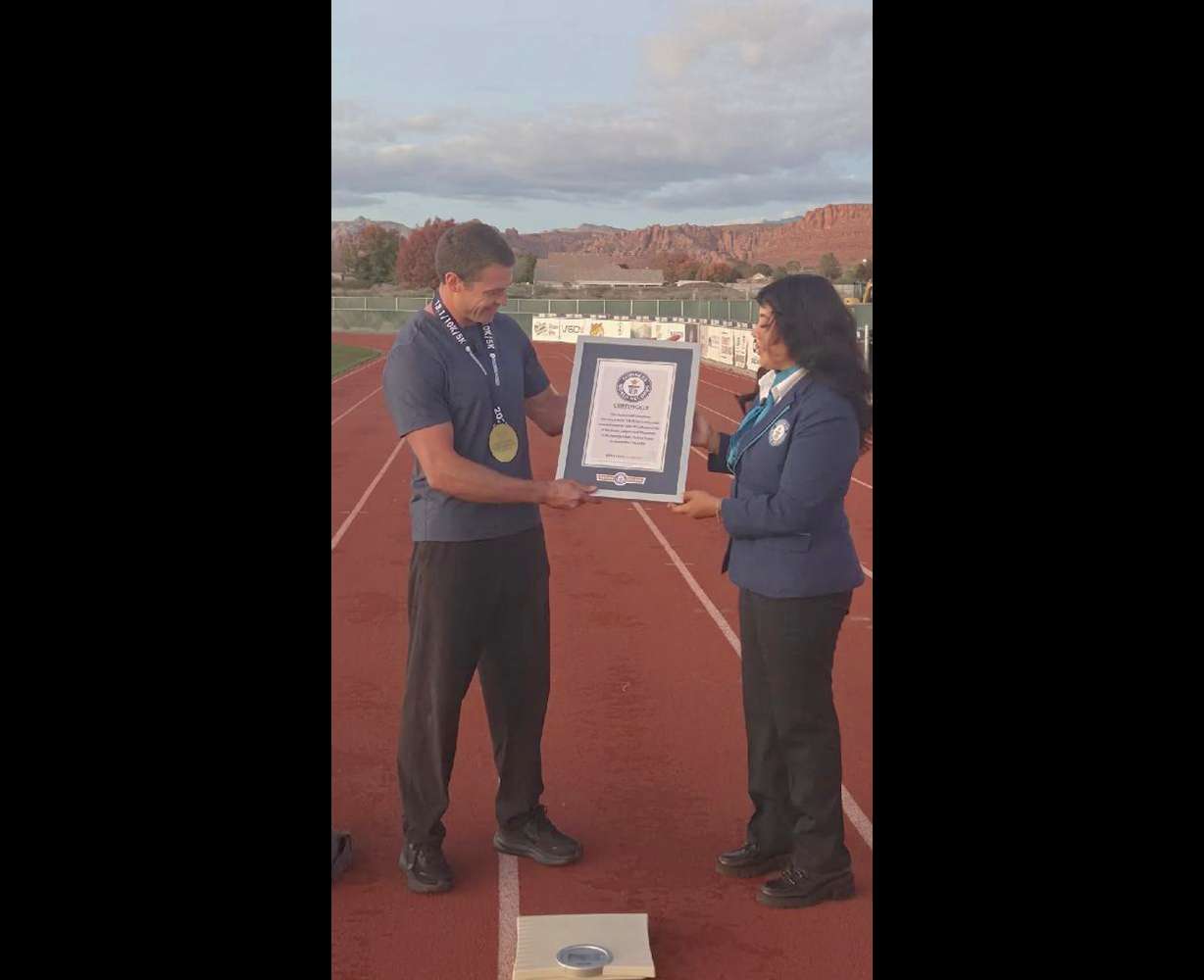
"I'm really just bringing awareness to (every person) about their mitochondria, the importance of them and how to take care of them," he said. "When I first put the pack on, it was really hard, and there's no way I could have just done it from day one. But with that consistency of training and adapting, I was able to perform this. It's also showing that your body is quite resilient."
LeBaron, who also teaches an advanced exercise physiology class at Southern Utah University, said the science behind exercise has always intrigued him. He hopes to spread more awareness through additional weighted world record attempts.
"I'm going to try to set several more world records throughout 2027 and continue this idea of bringing awareness to Countdown's mitochondria research," he said. "I'm sort of pioneering this movement where we can bring awareness because the majority of people would benefit from knowing more about mitochondria.
"It's just amazing what the body can do when you put exercise as a priority."