- Saratoga Springs and Eagle Mountain led Utah's growth from mid-2024 to mid-2025, per a new population report.
- Utah, Salt Lake and Washington counties anchored population growth across the state.
- Cities across Utah and Salt Lake counties also saw the largest population declines, led by Orem.
SALT LAKE CITY — More than half of Utahns live in a city with a population of 50,000 or more for the first time in state history, according to a population report.
It comes as 172 communities across Utah gained population between mid-2024 and mid-2025, while the rest either didn't experience any changes or lost population, the Utah Population Committee, which is overseen by the University of Utah Kem C. Gardner Policy Institute, noted in a subcounty population estimate report on Tuesday.
"We need population numbers so we can plan appropriately, so we can make decisions that are informed, and so we can allocate funds in a way that approximates the needs of all of these communities," said Natalie Gochnour, director of the Gardner Policy Institute.
Where people are moving to — and leaving
Utah's capital city remains the state's most populous by a wide margin, but a new report finds that a pair of cities in northern Utah County are once again at the top for growth.
Saratoga Springs jumped to the top of the state in growth between July 1, 2024, and July 1 of last year, gaining 4,682 residents, the report noted. Its growth rate of 8.4% also topped the list among 279 cities, towns and unincorporated areas across the state.
Eagle Mountain, its western neighbor, placed second in both categories, with 4,169 new residents and a growth rate of 6.8%. The two cities, combined, now have more than 125,000 residents. Lehi, Saratoga Springs' eastern neighbor, ranked fifth in net growth, adding 2,386 residents over the past year, underscoring the region's dominance in growth.
Half of the 10 fastest-growing communities were located in Utah County. Spanish Fork and Mapleton placed sixth and eighth statewide, respectively.
Salt Lake and Washington counties each accounted for two cities on the list. Their most populated cities — Salt Lake City and St. George — also placed in the top five in terms of numeric growth.
Salt Lake City, which topped all communities in growth over the past two years, surpassed 220,000 residents in the process, the report noted. Meanwhile, Washington, Washington County was seventh in growth and Magna placed 10th.
Tooele's population gain of 1,293 was the ninth-largest overall, the only other county in the Top 10 in the category.
Spanish Fork placed fifth in percentage growth, marking the only other Utah County city to land in the Top 10 in that category. It placed just behind Washington and West Haven in the top five in percentage growth.
Utah's 10 Fastest-Growing Communities
These were Utah's fastest-growing towns and cities between mid-2024 and mid-2025, based on the total number of people added (numeric growth) and the rate of growth (percentage growth), according to the Utah Population Committee.
Numeric Growth
- Saratoga Springs: 4,682
- Eagle Mountain: 4,169
- Salt Lake City: 3,303
- St. George: 3,303
- Lehi: 2,386
- Spanish Fork: 1,777
- Washington, Washington County: 1,498
- Mapleton: 1,336
- Tooele: 1,293
- Magna: 1,277
Percentage Growth
- Saratoga Springs: 8.4%
- Eagle Mountain: 6.8%
- Washington: 4.1%
- West Haven: 3.9%
- Spanish Fork: 3.7%
- Magna: 3.6%
- Heber City: 3.5%
- Tooele: 3.2%
- Hurricane: 3%
- Cedar City: 2.8%
Interestingly enough, cities across Utah and Salt Lake counties also led in population decline.
Orem experienced the biggest drop, losing an estimated 943 residents over the past year. Sandy followed with a loss of 751 residents, while Provo (-498), Kearns (-286) and Taylorsville (-274) rounded out the bottom five in population growth.
Cedar Hills' loss of 116 residents led to a population decline rate of 1.2%, the lowest among all communities.
"We need population numbers so we can plan appropriately, so we can make decisions that are informed, and so we can allocate funds in a way that approximates the needs of all of these communities," said Natalie Gochnour, director of the Gardner Policy Institute.
Utah's shifting population trends
The committee has estimated county populations for years, along with a statewide population estimate, but Tuesday's report is the first time that it has released subcounty populations. That's something that the U.S. Census Bureau typically tracks, usually using a different methodology.
Researchers used the 2020 census as a base, and then used building and population data from various sources, such as building permits or dormitory data, to create estimates for every year since, said Megan Rabe, a demographic research associate for the institute. All of these were geocoded to make sure they fell within the appropriate boundaries.
The numbers ultimately paint a clearer picture of where Utah's growth is taking place, following a committee report released in December that broke down countywide estimates. It found that Utah County gained 15,914 new residents, accounting for over one-third of the state's estimated growth in 2025.
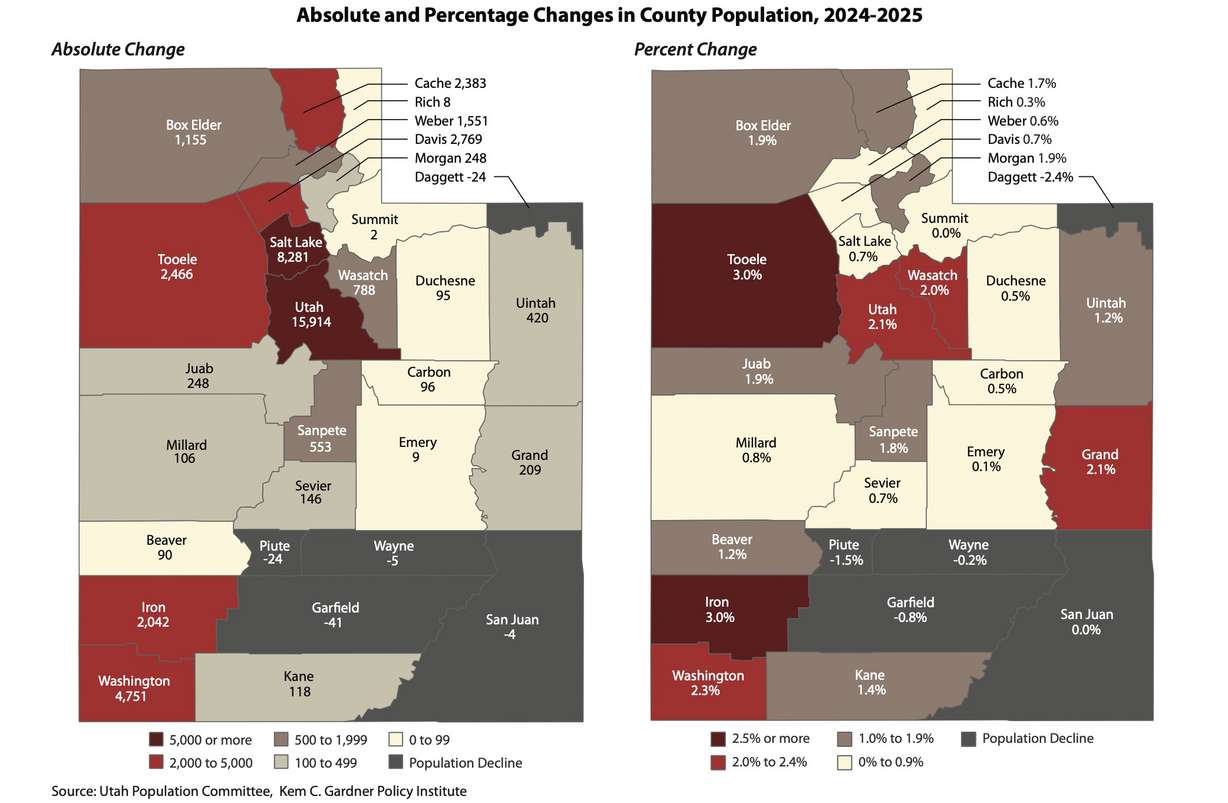
That report also noted that Salt Lake and Washington counties were major drivers in growth, all of which explains how most Utahns ended up in cities with at least 50,000 residents. "Ring counties" outside of the Wasatch Front and Washington County were also big draws.
Yet, neither report explains why some areas grow faster than others — or why certain cities shrink within growth areas.
Its authors have their suspicions. Regions like the Point of the Mountain, between southern Salt Lake and northern Utah counties, have space to build new homes where jobs are. Places like Salt Lake City have leaned into more redevelopment with taller, larger buildings, said Mallory Bateman, director of demographic research at the institute.
Smaller communities could face a mix of older populations aging out or fewer people moving in. At the same time, children leaving homes and lower birth rates could be behind some of the bigger cities that lost population after once anchoring the state's growth.
"We also know that movers to the state are typically younger adults, so those household sizes are smaller," she said. "There are a lot of factors at play."
Higher housing costs could also factor into the equation.
The data show there's plenty of variation within Utah's growth, Gochnour adds. Utah's growth is a story with many unique chapters. It's also a story that can quickly change.
"Population is always in motion," she said.