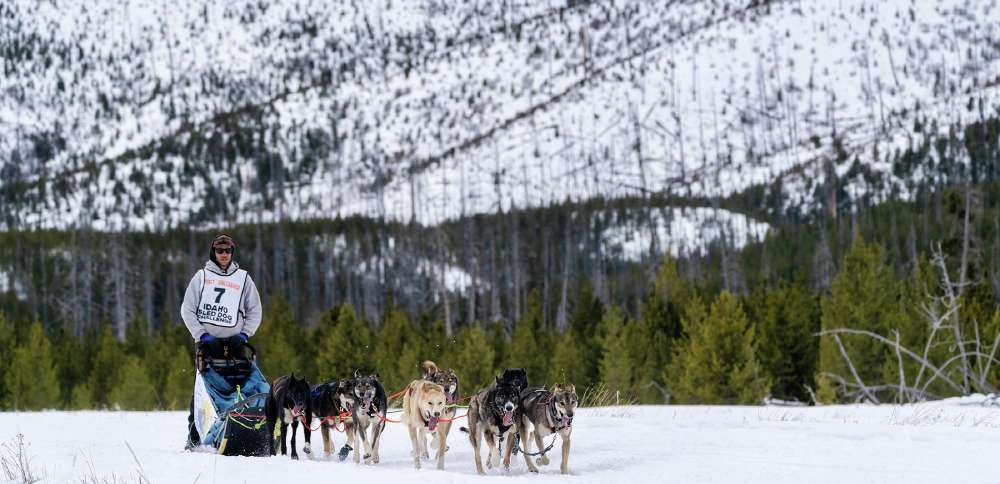
- The Idaho Sled Dog Challenge, one of the more challenging sled dog races in the U.S., is ceasing operations.
- Record-low snowpack in Idaho contributed to the race's cancellation this year.
- Organizers said they no longer had a reliable trail after three years of snow-related issues.
SALT LAKE CITY — Organizers of the Idaho Sled Dog Challenge, one of the premier sled dog races in the contiguous U.S., say they're calling it quits, citing three consecutive years of snow-related disruptions.
"Without a reliable trail, our board of directors feel it is too much to ask of our volunteers and sponsors to continue, so we've decided it's time for all good things to come to an end. The Idaho Sled Dog Challenge will have no future races," Jerry Wortley, founder and organizer of the event, said in a statement Monday.
The announcement came as Idaho's statewide snowpack collection this year reached a record low for this point in the season, according to the Natural Resources Conservation Service data. It joined Utah and Colorado as Western states with record-low snowpacks at the start of this week.
Utah's northern neighbor has struggled with the same dilemma that has impacted snow conditions in the Beehive State. Idaho's average temperature of 36.2 degrees Fahrenheit between October and January is tied for the warmest first third of a water year in state history, matching a similar start during the 1934 water year, per the National Centers for Environmental Information.
While precipitation has been above normal during that time, it's made it difficult to produce snow in many middle and lower-level areas. This year's 100-mile and 300-mile races were originally scheduled to begin last week, but organizers announced last month they had been canceled over "dismal snow levels and unsafe trail conditions," as well as little hope that the situation would improve in time for the Feb. 2 opening date.
There was still enough snow to hold the Warm Lake Stage Race that wrapped up on Jan. 30. A Utah team led by musher Kayson Judd, of Coalville, won the event, which is also being dissolved as part of the Idaho Sled Dog Challenge's announcement on Monday.
The Idaho Sled Dog Challenge debuted in 2018 and quickly became one of the biggest sled dog races in the Lower 48. It attracted racers from as far away as New Hampshire and Canada, served as part of the "Rocky Mountain Triple Crown" and as a qualifier for the prestigious Iditarod in Alaska.
It was also billed as one of the toughest, featuring over 36,000 feet of climb through Idaho's mountainous terrain, Wortley explained. But it also endured unpredictable challenges, which started with the COVID-19 pandemic that ultimately led to the cancellation of the 2021 event.
Low snow conditions impacted events in 2024, while last year's events were disrupted by dangerous avalanche conditions. This year proved to be the final straw.
Competitors, volunteers and spectators took to social media to voice their appreciation of the event.
"(I'm) so grateful to be able to experience the Idaho Sled Dog Challenge," wrote Alexandra Ness, of Montana, a musher who placed third in the final Warm Lake Stage Race.
Wortley said the board is grateful for the "passionate reception" the event received in its short existence, ranging from families who supported the competitors to the hundreds of volunteers and sponsors who helped pull off every race.
"There are so many people and organizations to thank for your selfless support over the years," he said.