LAS VEGAS — During a prestigious gathering of experts in the business of college sports last week at the Aria Resort and Casino, Utah's thunderous news drew instant praise. At least publicly.
NCAA president Charlie Baker called the Utes' partnership with private equity firm Otro "really well thought out and really well designed."
Frank Azzopardi, who specializes in commercial transactions for the multinational firm Davis Polk, said the Utes have "certainly hit the right notes."
And Big 12 commissioner Brett Yormark remarked that "strategic alliances, whatever they look like, that help us create value for our member institutions is something I sign up for."
The comments came during a two-day forum on intercollegiate sports run by the Sports Business Journal. Panel discussions covered every topic imaginable, from NIL strategies to the new College Sports Commission, from the future of Olympic sports to the role stadiums and arenas can play in revenue generation. The event even featured a discussion on private capital.
The agenda was crafted months before Utah announced its groundbreaking deal with Otro, in which the New York-based equity firm will plow hundreds of millions into a new commercial entity, Utah Brands and Entertainment, that will house the athletic department's revenue-generating arms (e.g., corporate sponsorships, ticketing, event-related revenues, etc.).
In that regard, the timing of Utah's news was mere coincidence. But aside from Notre Dame's frustration-fueled reaction to the College Football Playoff snub, the Utes were the talk of the first day of the event.
"We talked to Utah about what they did," Baker said during his time on the stage, "and I think what they did was really well thought out and really well designed ...
"They still own the majority of the decision-making, they own the majority of the seats on the board, they got a minimum commitment with respect to how long they're going to be in and they also talked a lot about what they were seeking to achieve."
Privately, the reaction was muted.
The Hotline spoke to more than a half-dozen sources with expertise in sports business across the two-day forum. A few were cautiously optimistic about Utah's move; several adopted a neutral stance. But every response struck at least one of the following notes:
— Numerous schools are pondering partnerships with private equity firms, which provide cash infusions and organizational expertise during a time when both are desperately needed.
The rise of revenue sharing with athletes in 2025 has added a $20.5 million expense to budgets across the power conferences, while the need to maximize NIL resources remains critical.
Utah became the first, which generated praise across the industry. "Because there's no market for this, they should be able to get favorable terms," one source said.
Once details emerge, a parade of schools could follow the Utes into the world of private equity.
— Utah president Taylor Randall knows his way around a budget better than many of his peers in Ivory Towers. He was dean of Utah's business school and has a doctorate in information management.
The university's board of trustees is financially savvy, as well. Vice chair David Parkin, for example, is the co-founder of a private equity fund.
"Of all the schools," the source added, "Utah is probably better positioned to make this work than most."
— Several sources refrained from judging the merits of Utah's plan because details remain scarce — and the details mean everything.
How much up-front cash will Otro provide, and how will it be deployed?
Borrowing dollars to pay down debt is a poor use of funds and will create a deeper hole for the Utes. But if the vast majority of Otro's capital is plowed into revenue-generating endeavors, the Utes could maximize the opportunity provided.
What is the expected rate of return, and how much will be funneled to Otro?
Also, how does the new commercial subsidiary, Utah Brands and Entertainment, plan to generate enough annual revenue to satisfy Otro's required returns? There's only so much untapped cash available through ticket sales and sponsorships. The Utes need to unlock a new revenue stream.
And what are the consequences if they cannot create enough new revenue to satisfy the terms of the private equity agreement?
Make no mistake, Utah's plan is stocked with both risk and reward in equal doses that, at this point, are impossible to handicap.
But in one regard — Utah's motivation for taking the private equity plunge — there is plenty of clarity.
The Utes are facing challenges on three levels:
- As noted above, the Utes are navigating the same economic changes (revenue sharing and NIL) battering budgets across the major college landscape. Utah has always operated efficiently, but every aspect of the athletic department is under stress like never before.
- BYU poses a serious threat.
With their impossibly deep pockets, the Cougars have overtaken Utah competitively in the major sports, football and men's basketball, and the Utes don't have a viable countermove. Their donor base cannot compete with BYU's when it comes to funding NIL.
(Outside of Texas Tech, nobody in the Big 12 can match the Cougars. The two schools have the potential to leave everyone else in the conference behind.)
External capital used to fund rosters and generate revenue, thus creating a virtuous circle for the future, was viewed by Utah's administration as the most effective response to the treasure chest in the center of Provo.
- The final challenge is more theoretical: whatever comes next for college football.
Whether a super league forms or the SEC and Big Ten create another round of realignment, the sport's structure is sure to change in the early 2030s, when a series of media rights contracts expire and the industry can be reimagined.
The most successful programs in the Big 12 and ACC over the next five or six years will have the best chance to secure a spot in the first-class cabin.
Utah has long-haul designs on membership in the Big Ten, or the super league.
Credit the Utes for taking the steps they believe are required to secure that future despite the risks. Which are immense.

Most recent Big 12 stories
Related topics
 Jon Wilner
Jon Wilner has been covering college sports for decades and is an AP Top 25 football and basketball voter as well as a Heisman Trophy voter. He was named Beat Writer of the Year in 2013 by the Football Writers Association of America for his coverage of the Pac-12, won first place for feature writing in 2016 in the Associated Press Sports Editors writing contest and is a five-time APSE honoree. You can follow him on Twitter @WilnerHotline or send an email at jwilner@bayareanewsgroup.com.
Pac-12 Hotline: Subscribe to the Pac-12 Hotline Newsletter. Pac-12 Hotline is not endorsed or sponsored by the Pac-12 Conference, and the views expressed herein do not necessarily reflect the views of the Conference.
More stories you may be interested in
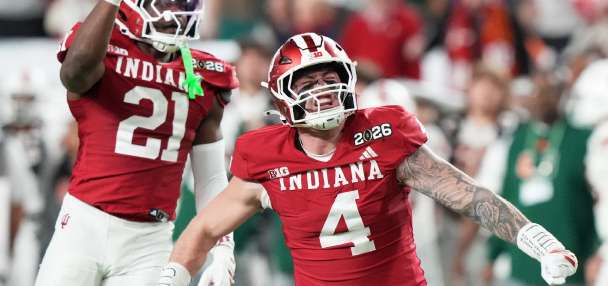
The Hotline's (ridiculously) early Top 25 for the 2026 season: Indiana, Texas, Oregon and Notre Dame lead the way

Holy Score: On Kyle Whittingham's move to Michigan, and the surreal moment that changed trajectories
Holy Score: Sitake's new deal, BYU's double down and the not-so-slow death of parity in the Big 12