'%3e%3cpath%20d='M34.1406%205.85938C30.3906%202.10547%2025.3047%200%2020%200C14.6953%200%209.60938%202.10547%205.85938%205.85938C2.10938%209.61328%200%2014.6953%200%2020C0%2025.3047%202.10547%2030.3906%205.85938%2034.1406C9.61328%2037.8906%2014.6953%2040%2020%2040C25.3047%2040%2030.3906%2037.8945%2034.1406%2034.1406C37.8906%2030.3906%2040%2025.3047%2040%2020C40%2014.6953%2037.8945%209.60938%2034.1406%205.85938ZM37.0117%2023.543H31.1602V13.5391H27.6328V19.9414C28.1211%2020.6914%2028.3711%2021.582%2028.3711%2022.5625V22.625C28.3711%2023.668%2028.1172%2024.6055%2027.6328%2025.4297V26.6094H36.082C33.4883%2032.9375%2027.2891%2037.3789%2020.0039%2037.3789C10.3711%2037.3789%202.62109%2029.6289%202.62109%2020C2.62109%2010.3711%2010.3711%202.62109%2020%202.62109C29.6289%202.62109%2037.3789%2010.3711%2037.3789%2020C37.3789%2021.1484%2037.2617%2022.2656%2037.0508%2023.3477C37.0391%2023.4141%2037.0234%2023.4766%2037.0117%2023.543Z'%20fill='white'/%3e%3cpath%20d='M22.3086%2018.5352C20.4336%2018.125%2019.9531%2017.8398%2019.9766%2017.1836V17.1406C19.9766%2016.6992%2020.3477%2016.2148%2021.4023%2016.2148C22.582%2016.2148%2023.8867%2016.6797%2025.0781%2017.4766L26.8516%2015.0195C25.4453%2013.8906%2023.707%2013.3398%2021.5547%2013.3398C18.5195%2013.3398%2016.4375%2015%2016.4063%2017.4766V17.5352C16.3633%2020.2617%2018.5859%2020.9805%2021.293%2021.6016C23.0391%2021.9766%2023.5703%2022.3164%2023.5703%2022.9609L23.5469%2022.9766C23.5469%2023.3906%2023.2578%2023.7031%2022.7852%2023.8359C22.5742%2023.9062%2022.1289%2023.9727%2021.5156%2023.9727C20.7617%2023.9727%2019.7539%2023.8633%2018.6328%2023.4844C18.0898%2023.2891%2017.4727%2023.0039%2016.8047%2022.6133L20.1406%2026.625C20.2813%2026.6602%2021.0977%2026.8516%2021.7734%2026.8516C25.0039%2026.8516%2027.0859%2025.2461%2027.1094%2022.6328V22.5703C27.1602%2020.1133%2025.2148%2019.1719%2022.3086%2018.5352Z'%20fill='white'/%3e%3cpath%20d='M5.24219%2013.5664V26.6133H8.75391V23.7578L10.2969%2021.9531L14.2031%2026.6133H18.3867L12.3555%2019.5195L17.4023%2013.5664H13.4531L8.75391%2019.0586V13.5664H5.24219Z'%20fill='white'/%3e%3c/g%3e%3cdefs%3e%3cclipPath%20id='clip0_97_2430'%3e%3crect%20width='40'%20height='40'%20fill='white'/%3e%3c/clipPath%3e%3c/defs%3e%3c/svg%3e)


- Salt Lake City Department of Public Utilities faces $600M debt after large infrastructure projects.
- Audit suggests cost-cutting and exploring property taxes to manage future needs.
- City is looking at new billing system while seeking federal funds to reduce financial burdens.
SALT LAKE CITY — Utah's capital city has prepared for the future by investing in major infrastructure improvements and planning for future capital needs, legislative auditors say.
However, while they found no evidence that any "enterprise funds were used inappropriately," auditors say that the previous way to pay for these projects also left its public utilities department with massive debt and those who rely on the department for water, sewage and other utilities paying much more.
Those were some of the key findings from a report that the Office of the Legislative Auditor General released on Tuesday. State leaders appeared surprised by some of the findings, urging the Salt Lake City Department of Public Utilities to find ways to trim costs amid concerns about affordability in Utah and across the country.
"When you see stuff like this happen inside Salt Lake City, it raises big questions, so anything that can be done to streamline and help save money probably ought to be looked at," said Utah House Speaker Mike Schultz, R-Hooper.
Inside the debt
The audit analyzed rate increases that Salt Lake City Public Utilities implemented in recent years. The department supplies water, sewage and other services to the city and a few others in the Salt Lake Valley, and began raising rates in recent years to pay off a few recent infrastructure projects.
Projects to build a new water reclamation facility and City Creek water treatment plant, which they say were required to meet federal standards, cost over $1 billion combined, department officials point out. It currently carries more than $600 million in debt tied to these projects, per the audit.
But it warned that the debt was assumed with "no feasible plan to pay it and future debt off," which led to the department implementing "short-term plans that have resulted in significant increases in sewer rates for non-residential customers."
For instance, the department switched its sewer rate model during the 2025 fiscal year, which is believed to have created over a 110% increase for a combination of schools, charities and churches users, legislative auditors noted.
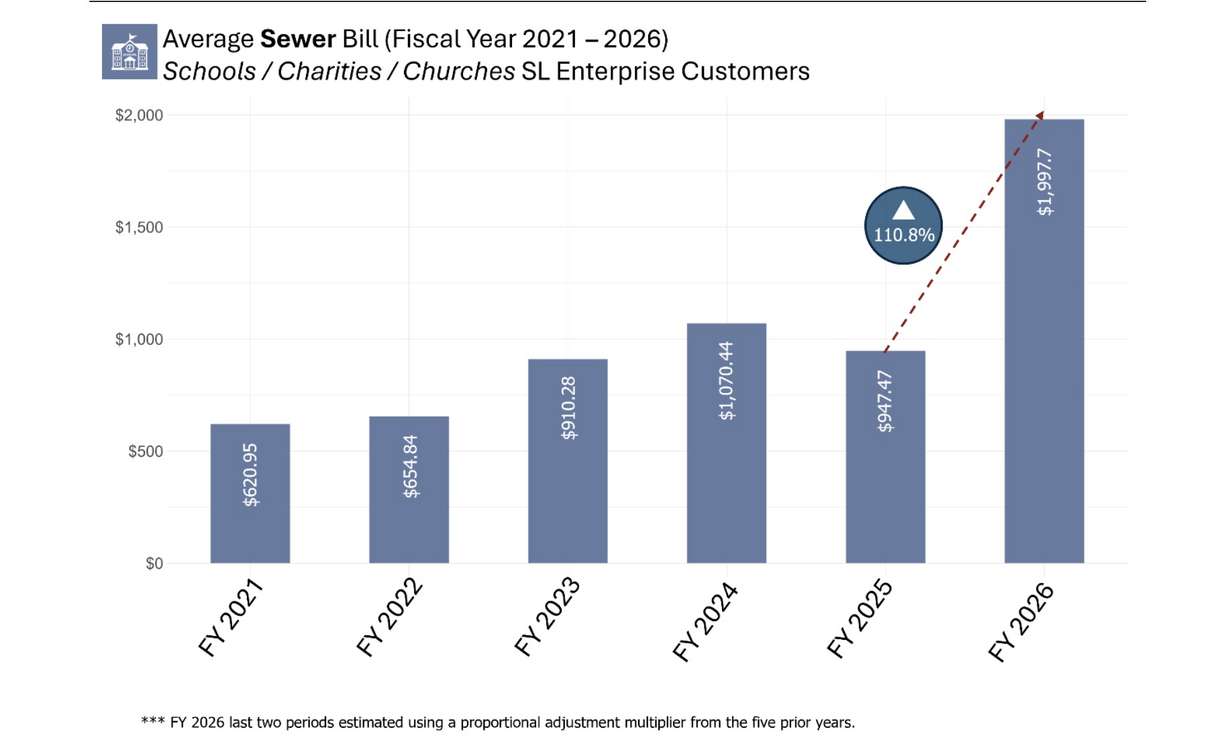
They added that the department couldn't show sewer charges were "accurate, equitable and consistently applied across non-residential customer groups" with the new model.
At the same time, it's struggled to pay off the existing debt.
There's more to come, too. Laura Briefer, the department's director, estimates there's another $2 billion worth of infrastructure upgrades needed over the next two decades as aging infrastructure reaches the end of its lifecycle.
It's a challenge tied to having a growing demand on one of the oldest retail water providers in the West, along with the first water and wastewater infrastructure in the state.
Possible solutions
The audit focused on ways for the department to plan and pay for the future without piling on debt. This could include a property tax that's solely for the department and potentially switching from a city department to a water district, said Morgan Hagey, the strategic lead auditor.
Utah's audit recommendations
- The department should formally ask the Salt Lake City leaders to consider funding changes needed for long-term financial sustainability, including a dedicated property-tax-supported revenue tool or comparable stabilization mechanism.
- If not given sufficient financial stability, the department should ask city leaders to evaluate alternative governance models, including an independent water and sewer district or similar entity.
- The department should "develop, document and periodically evaluate the methodology" used to estimate sewer flow for non-residential customers to avoid significant bill increases.
- It should also use its new billing system to improve billing accuracy, transparency and equity, while also developing, documenting and periodically evaluating its methodology used to estimate sewer flow for non-residential customers.
- The system should capture the customer data, meter information, billing adjustments and reporting needed to evaluate billing outcomes and identify customers affected by current rate methodologies.
She noted that all the recommendations can be made without legislative oversight.
"Our concern is mostly for the state's liability when it comes to the risk that Salt Lake City faces from aging infrastructure and very expensive projects," she said.
Salt Lake City agrees with the recommendations, said Briefer and Rachel Otto, chief of staff for Mayor Erin Mendenhall.
The department is already in the process of implementing a new billing system that will better inform future rate studies. It's also seeking to distance itself from taking on new debt as much as possible, instead focusing on building up as much reserve funds as possible, she added.
City officials secured nearly $38 million for the City Creek project from a federal grant, as well as $39 million in low-interest and forgivable loans for lead service line replacements, which is another massive project now underway.
That's something the city's public utilities department will try to seek more of, but it could explore property tax concepts, although Briefer cautioned that could also have constraints.
"We are trying to be as creative as possible to reduce the future burdens on our residents," she said. "Debt can be useful, but accumulating more debt actually increases the rate burden further down the road, so we'd like to really get started with that reserve fund."
In a letter to the state, Otto wrote that "preparation of long-term financial plans and updated rate studies" has already started, and will be presented ahead of the next fiscal year, which begins on July 1, 2027. They will "integrate long-range infrastructure and operational needs with revenue strategies."
The city still believes that current governance "can provide sufficient financial stability" in the future, though, especially because both the city and department still maintain a AAA bond rating.
It's working on the other recommendations, as well, she added.
Members of the Legislative Audit Subcommittee ultimately passed the audit on to the Utah Legislature's political subdivisions interim committee and transportation and infrastructure subcommittee for possible future action.