- Noah Reeb, a 14-year-old former patient, helped break ground on Huntsman Cancer Institute's expansion.
- The expansion will double the proton therapy center's capacity.
- Proton therapy is used to treat tumors near critical structures and is especially helpful for treating children's cancers.
SALT LAKE CITY — When Noah Reeb was 9 years old, he was diagnosed with a brain tumor. A new proton therapy center at the Huntsman Cancer Institute allowed him to receive treatment in Utah, simplifying what was already an overwhelming time for his family.
At that time, in 2021, he helped cut the ribbon and became the first patient at the Senator Orrin G. Hatch Proton Therapy Center.
Noah, now 14, returned recently to climb into the driver's seat of an excavator on the hillside behind the Huntsman Cancer Institute and break ground on an expansion that will double its capacity and help even more people receive the treatment that saved his life.
Proton therapy is a radiation treatment that uses high-energy beams to deliver a dose of radiation, which lowers the radiation other tissues are exposed to. It is used to treat tumors in the brain or spinal cord. There are just 48 proton therapy centers in the United States, and only one within a 500-mile radius of Salt Lake City.
Right now, the proton therapy center treats patients from Utah, Idaho, Montana, Nevada, Wyoming and Colorado.
The $43 million, 9,000-square-foot expansion includes a three-story treatment vault built into the hillside behind the Huntsman Cancer Institute. It will house patient spaces and the treatment unit, with specialized concrete and controlled temperature systems to contain the radiation and improve precision. It will be built by Jacobsen Construction.
Brad Cairns, CEO of the Huntsman Cancer Institute, said the center has already had a profound impact and brought care closer to home for many families while creating opportunities to study and improve proton therapy.
"(The) groundbreaking is a major expansion of our proton therapy facility which marks an important next chapter in our commitment for delivering the most innovative and compassionate care possible that reflects both scientific excellence and our service to the community," he said.
Noah said he trusted in the team caring for him, and remembers feeling "calm and hopeful" during his treatments.
"Looking back, I realize how big it is to have this kind of care here in Utah. It makes me feel really good knowing more kids will have that same opportunity," he said.
His father, James Reeb, wasn't prepared for the emotion he would feel as he entered the proton therapy center for the first time since 2021 for the groundbreaking.
"No matter what has happened in my life since Noah rang the bell as a cancer-free patient, I feel like I have won the lottery every time I look at him. It makes my heart burst. Noah and our family are so lucky and so blessed," he said.
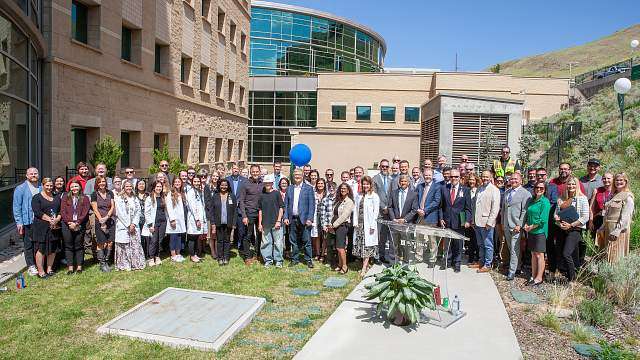
Dr. Matthew Poppe, physician scientist and professor of radiation oncology, said proton therapy is an "important advancement" in cancer care that is especially helpful for young people and patients with tumors near critical structures.
"This important expansion will enable us to better serve our patients by increasing access to this advanced technology closer to home and also expand our research opportunities," Poppe said.
The center has treated over 600 patients, one-third of which were children who receive care in coordination with Primary Children's Hospital. Treatment requires daily visits over several weeks.